
Product Whitepaper

# Revision History
| Date | Manual Version | Applicable Product | Update Description |
|---|---|---|---|
| December 2024 | V2.0.2 | ALB | Added copyright statement and other content |
| December 2025 | V2.0.5 | ALB | Product upgrade |
| June 2026 | V2.0.6 | ALB | Brand-new product upgrade |
# Introduction
With the sustained and rapid development of Internet technologies and applications, the R&D model of industry software has evolved from monolithic architectures to distributed architectures, and now to microservices architectures, relying more and more heavily on the "entry point" of applications and services. Traditional application entry points mainly include hardware load balancers, software load balancers, and some web servers with reverse proxy capabilities. Traditional application middleware generally also embeds a load balancer — for example, when Kingdee Apusic Application Server (AAS) was launched in 2000, it came with a Java-based load balancer that served as a unified application entry point, providing cluster scheduling and load balancing. However, in the era of cloud computing and microservices, traditional technologies no longer fit the new application models, and load balancing technologies and products face the challenge of upgrading.
What exactly has changed about load balancing under cloud and microservices architectures? First, traditional load balancing usually only solves the entry problem of a single application, while cloud environments bring diverse entry points — what we face is no longer a single entry point of one application, but complex entry points mixing different applications and services. Second, traditional load balancing usually performs URL-based, coarse-grained load scheduling, while cloud environments often require component-level and service-level fine-grained scheduling, such as precisely considering the orchestration and call-chain relationships between different services. Finally, the processing capacity of traditional load balancing is relatively limited — handling 10K-level requests was already considered good — while cloud environments often require a processing capacity of 100K-level or even 1000K-level requests and above.
Therefore, Kingdee Tianyan initiated an upgrade of its load balancer product, adopting a brand-new technical route and architecture, evolving it from a module embedded in the AAS application server into an independent load balancing software product.
# Development History
- June 2026: ALB V2.0.6 Standard Edition was released, with a fully updated console along with product optimizations and fixes.
- December 2025: ALB V2.0.5 Standard Edition was released.
- October 2024: The ALB native high-availability component V1.0 was released, enabling one-click deployment of active-standby high-availability clusters.
- December 2023: ALB V2.0 Standard Edition was adapted to multiple domestic software and hardware systems.
- July 2023: ALB V2.0 Standard Edition was released, providing the ability to quickly replace Nginx.
- June 2022: ALB V2.1 was released, supporting three-role permission management and multi-instance deployment management.
- December 2021: ALB V2.0 was released, providing plugin extension capabilities and adapting to multiple domestic software and hardware systems.
- August 2021: ALB V1.1 was released, providing dynamic proxy and quick installation features.
- July 2021: The ALB V2.0 project was launched to adapt to domestic software and hardware systems and be compatible with Nginx.
- July 2021: The complete ALB V1.0 was released, providing load balancing capabilities for AAS.
- May 2021: ALB V1.0 beta was released with service proxy capabilities.
- January 2021: The self-developed load balancer software project was initiated.
# Product Overview
Kingdee Apusic Load Balancer (ALB) is a high-performance, high-availability web server. ALB not only efficiently manages client requests and traffic in large-scale clusters, but also functions as a service proxy and a microservices gateway. As a service proxy, ALB is responsible for request load balancing, security control, authentication, and filtering, ensuring the quality of backend services. As a microservices gateway, it not only isolates clients from directly accessing microservice application systems, but also provides route management, dynamic configuration, custom plugin support, fine-grained traffic splitting, and third-party service discovery, enabling one-stop rapid onboarding of microservices.
# Product Name
The product name is Kingdee Apusic Load Balancer V2.0, abbreviated as ALB; the full English name is Apusic Load Balancer. For different usage scenarios, ALB is available in the following two editions:
- Enterprise Edition: Suitable for traditional service proxy and microservices gateway scenarios.
- Standard Edition: Suitable for high-availability and high-performance service proxy scenarios.
# Target Audience
- Enterprises with high-concurrency business scenarios that need load balancing.
- Application developers building distributed and microservices architectures.
- Enterprises and architectures with complex and numerous business systems that need unified proxying of network ingress and egress.
- Enterprises and institutions with static resource hosting needs; ALB can support static content proxying requirements.
# Kingdee Apusic Load Balancer Standard Edition
# Product Positioning
Kingdee Apusic Load Balancer Standard Edition (ALB Standard Edition) is a high-performance, high-concurrency web server and reverse proxy server with a lightweight, modular architecture and cross-platform capabilities. Designed to handle large numbers of concurrent connections, ALB Standard Edition provides core features such as static content serving, Layer-4/Layer-7 proxying, and load balancing, along with security features such as GM SSL, access control, and three-role permissions. The flexibility and extensibility of ALB Standard Edition make it an ideal choice for building high-performance websites and applications, especially in scenarios that need to handle large amounts of static resources and dynamic requests.
# Core Features
| Feature | Description |
|---|---|
| Static file serving | Supports static file caching, resumable downloads, and compressed transmission, enabling fast, low-latency static content distribution. |
| Reverse proxy | Supports reverse proxying for multiple protocols including HTTP/HTTPS (1/2/3), WebSocket, gRPC, FastCGI, TCP, and UDP. |
| Load balancing | Supports Layer-4 and Layer-7 load balancing, providing algorithms such as round robin, weighted round robin, least connections, IP hash, and session persistence. |
| High availability | Supports native high availability (AHA) deployment based on Keepalived, providing active-standby failover, virtual IP (VIP) failover, and configuration synchronization. |
| Security | Supports HTTPS, GM SSL mutual authentication, IP blacklists/whitelists, Referer blacklists/whitelists, access control, and hotlink protection for static resources. |
| Console | Provides a web-based visual console supporting site management, configuration management, certificate management, high availability management, log management, module management, system information, three-role permissions, and audit logs. |
| External API & AI Agent | Provides RESTful external APIs and the alb-cli command-line tool, allowing AI Agents such as Claude and OpenCode to perform automated operations through SKILL. |
| Migration tool | Provides an Nginx configuration migration tool that supports migrating Nginx configurations, static resources, SSL certificates, and more to ALB. |
| Cross-platform | Supports domestic software and hardware platforms, including CPU architectures such as Kunpeng, Loongson, Zhaoxin, Hygon, Phytium, and Sunway, and operating systems such as UnionTech UOS, Kylin, openEuler, Deepin, and NFSChina. |
| Monitoring | Supports collecting and displaying the running status, traffic, performance, configuration, and logs of ALB nodes, as well as scheduled log rotation, backup, and download. |
# Functional Architecture
ALB Standard Edition processes network requests based on a multi-process model and achieves high performance and high concurrency through a modular design. The console and the ALB proxy core work together: configurations made by users in the web console or through external APIs generate corresponding Nginx-compatible configuration files, which are automatically reloaded into the ALB proxy core. Meanwhile, the ALB proxy core sends running status, traffic, logs, and other data back to the console for display and analysis. This architecture retains ALB's high-performance forwarding capabilities while greatly improving operations efficiency through the visual console and open APIs.

# Key Features
# Service Proxy
| Feature | Description |
|---|---|
| Static file serving | Supports static file caching, resumable downloads, and compressed transmission, enabling fast, low-latency static content distribution. |
| Reverse proxy | Supports proxying of multiple protocols including HTTP/HTTPS (1/2/3), FastCGI, WebSocket, gRPC, TCP, and UDP. |
| Protocol support | Supports IPv4 and IPv6 dual-stack protocols. |
| Site management | Supports visual creation of HTTP/TCP/UDP sites via the web console, with advanced configurations such as Location, Upstream, SSL certificates, access control, rate limiting, and custom headers. |
# Load Balancing
| Feature | Description |
|---|---|
| Round robin | Distributes each request to different backend servers one by one in chronological order. |
| Weighted round robin | Generates traffic ratios for nodes based on their weights; suitable for backend servers with uneven performance. |
| Least connections | Selects the upstream service node with the fewest connections as the forwarding target. |
| Sticky (session persistence) | Maintains client affinity through cookies, ensuring that requests from the same client are always directed to the same backend server during a session, achieving cookie consistency. |
| IP hash | Computes the target node by hashing the IP address, ensuring that each visitor always accesses the same backend server, which solves session consistency problems. |
# Traffic Management
| Feature | Description |
|---|---|
| Request rate limiting | Limits the request rate to prevent upstream services from being overwhelmed by too many requests at once. |
| Request count limiting | Limits the number of requests a client can make per unit of time. |
| Concurrency limiting | Limits the number of connections allowed for a client per unit of time. |
# Security
| Feature | Description |
|---|---|
| HTTPS | Supports HTTP/HTTPS to ensure secure and trusted communication between clients and servers. |
| GM SSL | Supports GM SSL mutual-authentication communication to ensure secure and trusted communication between clients and servers; supports automatically binding uploaded certificates to existing sites and automatically generating test certificates. |
| Access control | Supports IP access control, IP blacklists/whitelists, Referer blacklists/whitelists, and hotlink protection for static resources. |
| Three-role permissions | The ALB console supports the MLPS 2.0 three-role permission model, supporting role and permission management, user security policy configuration, and audit log viewing. |
# Operations and Management
| Feature | Description |
|---|---|
| Web console | Provides a visual interface supporting site management, configuration management, certificate management, high availability management, log management, module management, and system information viewing. |
| Configuration management | Supports online editing, syntax highlighting, auto-completion, full backup, and restoration of Nginx-compatible configuration files. |
| High availability management | Supports creating and managing Keepalived-based high availability clusters and synchronizing configurations from the master node to backup nodes. |
| Log management | Supports scheduled rotation, backup, and download of log files as configured, facilitating auditing and troubleshooting. |
| Module management | Supports uploading third-party modules, enabling/disabling modules, and viewing detailed module information. |
| System information | Supports viewing ALB license information and updating licenses, as well as smooth upgrade and rollback of the ALB proxy core and console. |
| External API & CLI | Provides RESTful external APIs and the alb-cli command-line tool, supporting site management, status monitoring, configuration reload, log query, and more. |
| AI Agent | Allows AI Agents such as Claude and OpenCode to invoke alb-cli through SKILL, enabling natural-language-driven daily inspection and troubleshooting. |
# Product Advantages
Nginx Compatibility
ALB Standard Edition is fully compatible with Nginx 1.10 through Nginx 1.30 and supports the Nginx configuration file format, enabling rapid migration and replacement of Nginx configuration files.
Easy-to-Use Web Console
ALB provides an integrated web management console. The interface has been comprehensively optimized and upgraded in V2.0.6, supporting node running status monitoring, traffic and performance data display, site management, module management, log management, online migration, three-role permission management, audit log viewing, and unified management of configuration files and SSL certificates.
Adapted to Domestic Environments
ALB Standard Edition runs securely, stably, and efficiently on domestic software and hardware systems. Supported hardware architectures include Kunpeng, Loongson, Zhaoxin, Hygon, Phytium, and Sunway; supported operating systems include UnionTech UOS, Kylin, openEuler, Deepin, and NFSChina.
GM SSL
ALB Standard Edition supports GM SSL mutual-authentication communication, supports automatically binding uploaded certificates to existing sites, and supports automatically generating test certificates, ensuring secure and trusted communication between clients and servers.
Lua Scripting Extensions
ALB Standard Edition supports Lua scripting extensions, meeting customers' custom development needs for traffic ingress, traffic processing, reverse proxying, log recording, and other business scenarios.
Open APIs and AI Agents
ALB Standard Edition provides RESTful external APIs, the alb-cli command-line tool, and SKILL for AI Agents, making it easy to integrate with CI/CD, ERP, operations monitoring, and other systems, and supporting the introduction of AI assistants such as Claude and OpenCode for automated operations and troubleshooting.
# Application Scenarios
Unified Traffic Ingress and Egress
ALB Standard Edition supports security verification, rate limiting, speed limiting, and load balancing of access traffic. It supports unified security verification and management of inbound and outbound traffic for complex application platforms, as well as statistics and auditing of access traffic, enabling unified control of backend access traffic from the entry point.
Separation of Static and Dynamic Website Content
ALB Standard Edition supports proxying local static resources and reverse proxying backend services, supporting load balancing for applications with separated static/dynamic architectures. This speeds up user access to static code and resources and reduces the pressure on backend services.
Static Resource Hosting
ALB Standard Edition provides static file serving, including static file caching and resumable downloads, enabling fast, low-latency distribution of static content such as images, videos, and web page files. It helps customers build efficient content publishing platforms, improving website access speed and saving bandwidth costs.
Traffic Control and Custom Access Policies
ALB Standard Edition supports rate limiting and speed limiting, enabling precise control of access requests, such as connection count limits and request rate limits. This helps customers effectively handle traffic bursts, prevent service overload, and achieve stable service quality and protection against DDoS attacks.
Secure Reverse Proxy
ALB Standard Edition supports GM SSL mutual-authentication communication and multiple protocols including HTTP and HTTPS, ensuring secure proxying across protocols.
Automated Operations and AI Assistance
Through the external APIs, alb-cli, and AI Agent SKILL provided by ALB Standard Edition, customers can automatically publish sites in CI/CD pipelines, integrate ALB with ERP/operations platforms, and let AI assistants perform daily inspections, log analysis, and fault location.
# Kingdee Apusic Load Balancer Enterprise Edition
# Product Positioning
ALB meets the needs of large-scale clusters and cloud platforms for managing client access requests and traffic when providing client-facing services. It performs verification, processing, transformation, and distribution of access requests, isolating client access from the application systems, platforms, and resources that provide services, thereby achieving traffic control, access management, and load balancing for service cluster access.
# Core Features
| Feature | Description |
|---|---|
| Load balancing | ALB supports mainstream load balancing algorithms such as round robin, weighted round robin, and consistent hashing; supports non-affinity/affinity load balancing scenarios for stateless and stateful services; and supports HTTP and HTTPS reverse proxying as well as TCP/UDP and gRPC. |
| Global dynamic capability | Global dynamic capability means that configuration changes take effect immediately upon submission without restarting services and without affecting existing services. |
| Traffic management | ALB provides a comprehensive traffic management mechanism that can perform circuit breaking on upstream service access based on service response status, and supports managing service access by conditions such as traffic, user, client, referer, and domain name. |
| Plugin extension | ALB provides a rich set of scenario-based plugins that support routing and forwarding, traffic management, operations, security, and more, while allowing users to flexibly extend plugins according to their needs and scenarios. |
| Control center | ALB provides a graphical management control center through which users can manage and configure routes, upstream services, and plugins in the load balancer. |
# Functional Architecture
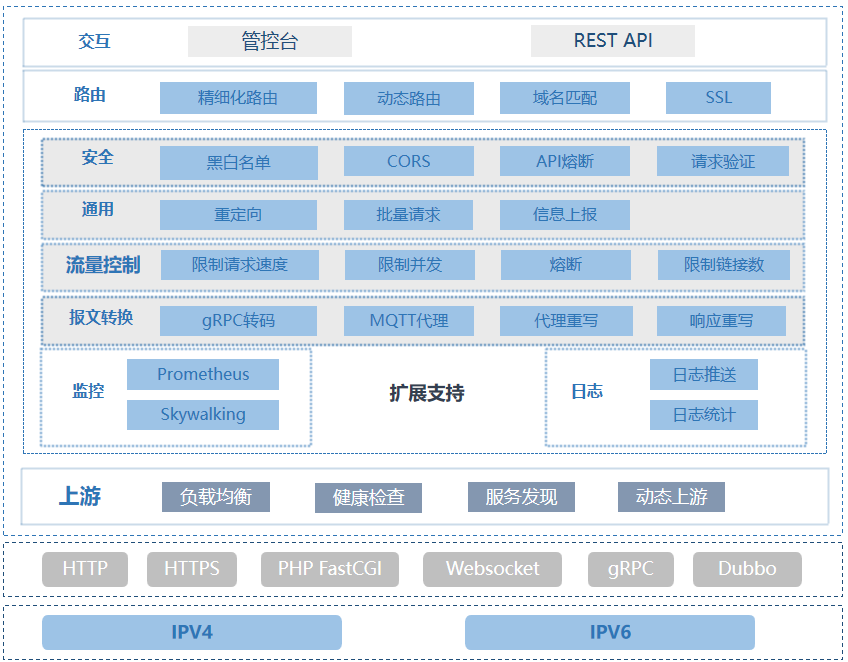
ALB proxies access requests through traffic processing and request forwarding. In the traffic processing phase, ALB can process access requests through plugins; the request processing pipeline is built with plugins, enabling the orchestration and application of processing logic such as authentication, logging, monitoring, protocol conversion, security, traffic control, and request message transformation. In the request forwarding phase, ALB forwards the processed access requests to upstream services according to a specific load distribution algorithm based on the processing results, completing the proxying of access requests.
# Key Features
# All Platforms
- Supports IT innovation (Xinchuang) platforms: runs on mainstream domestic platforms, supporting multiple server instruction sets such as x86 and ARM64.
- Cloud-native: supports cloud-native deployment and can be deployed in a variety of infrastructure/platform resources.
# Multi-Protocol Support
- HTTP(S).
- TCP/UDP.
- Dubbo.
- gRPC.
- MQTT, supporting MQTT 3.1.* and 5.0 standards.
- WebSocket.
- Static resource proxying.
- php_fcgi protocol.
# Node and Traffic Management
- Dynamic configuration updates: dynamic hot updates of configurations and plugins without service interruption.
- Proxy request rewriting: supports rewriting the host, uri, schema, enable_websocket, headers, and other information of access requests.
- Reverse proxy output rewriting: supports custom modification of the status code, body, headers, and other information of response content.
- Function invocation: supports adding and invoking custom functions before/after ALB processes access requests.
- Dynamic load balancing: supports load balancing algorithms such as weighted round robin and consistent hashing, and supports instant addition and removal of service endpoints.
- Health checks: supports health checks of service endpoints and automatically filters unhealthy nodes.
- Service circuit breaking: interrupts access based on the number/ratio of errors returned by service calls.
- Service mirroring: supports mirroring of access to servers.
- Traffic splitting: allows users to control traffic distribution among multiple upstream services.
- Traffic management: supports traffic management policies such as rate limiting, request count limiting, and concurrency limiting.
- Batch requests: supports batched HTTP requests based on HTTP pipelining.
# Fine-Grained Routing
- Path rule matching: supports full-path matching and prefix matching; supports custom route matching functions.
- Flexible routing conditions: users can use cookies, args, etc. as routing conditions, with various operators supported as routing judgment conditions.
- IPv6 support: supports matching routes in IPv6 format.
- Route lifecycle: supports automatic expiration configuration for routes.
- Route priority: supports priority configuration for routes.
# Security Protection
- IP blacklists/whitelists
- Referer whitelists
- Rate limiting
- Request count limiting
- Concurrency limiting
- ReDoS (Regular expression Denial of Service) defense: built-in policy that resists ReDoS without configuration.
- CORS: enable CORS for your APIs.
- URI interceptor: intercepts user requests based on URIs.
- Request validator.
# Operations-Friendly
- Observable performance management: supports visual tracing and management of performance with Apache SkyWalking and Zipkin.
- Integration with external service discovery: in addition to the built-in etcd, also supports the DNS discovery modes of Consul and Nacos.
- Monitoring and metrics: supports integration with Prometheus and Kingdee Apusic Monitoring Platform (AMP).
- High-availability clusters: ALB clusters ensure consistency among nodes through a unified configuration center and support dynamic scaling of the number of nodes.
- Graphical control center: supports configuration and management of ALB routes and services.
- Global rules: allows executing plugins on all requests, such as rate limiting and speed limiting.
- External loggers: supports exporting access logs to external log management tools.
# Highly Extensible
- Custom plugins: can be mounted to common phases such as init, rewrite, access, balancer, header filter, body filter, and log.
- Plugins can be written in Java/Go.
- Custom load balancing algorithms: custom load balancing algorithms can be used in the balancer phase.
- Custom routing: supports user-implemented routing algorithms.
# Technical Features
# Stable and Reliable Operation
ALB is based on a multi-process model, ensuring that an error in one request connection proxy does not affect other processes. After an abnormal process exits, its main process quickly creates a new process to ensure that service performance does not degrade. Multiple instances support shared configurations, and components support active-standby or load balancing, achieving higher reliability.
# High Concurrency Support
ALB supports extremely high concurrency through an asynchronous non-blocking mechanism combined with I/O multiplexing technology.
# Modular Design
ALB decouples the stages of request ingress, processing, load balancing, and response return, and embeds specific logic, achieving a personalized architecture that supports microservice traffic ingress, as well as supporting plugins written in Java/Go for business traffic management needs.
# Product Advantages
Global Dynamic Configuration
ALB configurations are WYSIWYG: submitted configuration changes take effect immediately without restarting or reloading the load balancer, enabling dynamic routing, dynamic upstreams, dynamic plugins, dynamic SSL certificate binding, and dynamic load balancing.
Multi-Protocol Proxying
ALB supports comprehensive proxying of Layer-4/Layer-7 network architecture protocols, covering HTTP, HTTPS, TCP/UDP, Dubbo, MQTT, gRPC, WebSocket, and PHP FastCGI.
Full Adaptation to IT Innovation Environments
ALB runs stably and efficiently on domestic operating systems and hardware architectures. Supported operating systems include UOS, Huawei openEuler, Kylin V10, and NFSChina; supported hardware systems include Phytium, Kunpeng, Zhaoxin, and Hygon hardware platforms.
Highly Extensible
ALB supports developing custom plugins in Lua, which can be embedded and executed at various load balancing stages to implement traffic management functions and meet differentiated load balancing needs.
Security Protection
ALB supports multiple identity authentication capabilities, including IP blacklists/whitelists, Referer whitelists, rate limiting, request count limiting, concurrency limiting, and CORS.
# Application Scenarios
Load Balancer for Application Service Clusters
ALB is deeply integrated with Apusic Application Server, supporting one-click enabling of the ALB load balancer in the AAS console, supporting dynamic load balancing of distributed applications running on AAS, as well as active health checks that promptly detect and shield faulty services, ensuring business continuity.
Separation of Static and Dynamic Website Content
ALB supports proxying local static resources and integrating multi-protocol backend services, supporting load balancing for applications with separated static/dynamic architectures, speeding up user access to static code and resources, and reducing pressure on backend services.
Horizontal Scaling of Website Service Capabilities
ALB provides dynamic upstream service integration, supports multiple load balancing algorithms and integration with external service discovery components, supports high-concurrency scenarios brought by business and website traffic growth, and achieves dynamic scaling of web service capacity for horizontal business expansion.
Unified Traffic Ingress and Egress
ALB supports security verification, rate limiting, and speed limiting of access traffic, and supports collecting and pushing access logs. It supports unified security verification and management of inbound and outbound traffic for complex application platforms, as well as statistics and auditing of access traffic, thereby achieving unified control of backend access traffic from the entry point.
# System Hardware and Software Requirements
# Hardware Environment
| ALB Edition | Hardware Platform | CPU Architecture | Memory | Storage |
|---|---|---|---|---|
| Enterprise Edition | Kunpeng | ARM | 4GB+ | 50GB+ |
| Enterprise Edition | Zhaoxin | x86 | 4GB+ | 50GB+ |
| Enterprise Edition | Hygon | x86 | 4GB+ | 50GB+ |
| Enterprise Edition | Phytium | ARM | 4GB+ | 50GB+ |
| Standard Edition | Kunpeng | ARM | 4GB+ | 50GB+ |
| Standard Edition | Zhaoxin | x86 | 4GB+ | 50GB+ |
| Standard Edition | Hygon | x86 | 4GB+ | 50GB+ |
| Standard Edition | Phytium | ARM | 4GB+ | 50GB+ |
| Standard Edition | Loongson | mips64, loongarch | 4GB+ | 50GB+ |
| Standard Edition | Sunway | sw64 | 4GB+ | 50GB+ |
Note: The above are minimum hardware requirements.
# Software Environment
- Operating systems: UOS, Kylin, Deepin, NFSChina, CentOS, Ubuntu
# Performance Specifications
| ALB Edition | Hardware Specification | Concurrency |
|---|---|---|
| Enterprise/Standard Edition | CPU: 4 cores, Memory: 8 GB | Up to 20,000 |
| Enterprise/Standard Edition | CPU: 8 cores, Memory: 16 GB | Up to 50,000 |
| Enterprise/Standard Edition | CPU: 8 cores, Memory: 32 GB | Up to 100,000 |
| Enterprise/Standard Edition | CPU: 16 cores, Memory: 48 GB | Up to 500,000 |
| Enterprise/Standard Edition | CPU: 32 cores, Memory: 64 GB | Up to 1,000,000 |