
Product Whitepaper

# Version History
| Date | Manual Version | Applicable Product | Update Description |
|---|---|---|---|
| Dec 2024 | V2.0.2 | ADMQ | Added copyright notices and other content |
| Dec 2025 | V2.0.5 | ADMQ | Product upgrade |
| Jun 2026 | V2.0.6 | ADMQ | Added the ADMQ dedicated engine series |
# Introduction
Message middleware primarily helps applications communicate asynchronously. In system architecture, it serves purposes such as peak shaving and valley filling, heterogeneous integration, application decoupling, and asynchronous isolation. Traditional message middleware evolved from the JMS specification — for example, the Kingdee Apusic message middleware that Apusic released around 2003. As internet applications grew, distributed message middleware such as RocketMQ, Kafka, and RabbitMQ began to emerge. Some of these products focus on throughput, some on high performance, and some on flexible routing; different products suit different application scenarios. Kafka, for instance, leans toward data stream processing and is mainly used for big data stream processing and log processing.
In recent years, as cloud computing and microservice architectures have gained popularity, distributed message queues are increasingly used in scenarios such as the Internet of Things (IoT), distributed transactions, real-time computing, and large-scale cache synchronization. In banking, for example, a distributed message queue can split a transaction into multiple local sub-transactions and process them asynchronously through the queue, which improves transaction processing efficiency and concurrency while reducing the likelihood of synchronous blocking and dirty reads. Distributed message queues can also support rapid analysis and processing of large-scale data, improving the efficiency and accuracy of risk assessment and data analysis.
In 2020, Kingdee Apusic began upgrading its traditional message middleware for the financial and telecommunications industries, turning its attention to a new generation of financial-grade message queue technology: developing a new generation of message middleware products and providing the related support services. Through continuous product evolution, ADMQ has taken shape in two product forms — the Enterprise Message Queue for large-scale messaging platform scenarios, and the ADMQ Dedicated Message Queue for open-source message replacement scenarios — fully meeting enterprises' message middleware needs at different levels.
# Development History
- Jun 2026 — ADMQ V2.0.6 released, adding dedicated message queues such as ADMQ for Kafka, ADMQ for RocketMQ, ADMQ for RabbitMQ, and ADMQ for MQTT.
- Dec 2024 — ADMQ V2.0.2 released, adding copyright notices and other content.
- Dec 2023 — ADMQ V2.0 Standard Edition adapted to multiple domestic software and hardware systems.
- Jul 2023 — ADMQ V2.0 Standard Edition released, providing enterprise-grade message middleware capabilities.
- Jun 2022 — ADMQ V2.1 released, supporting three-role permission management and multi-instance deployment management.
- Dec 2021 — ADMQ V2.0 released, providing plug-in extension capabilities and adapting to multiple domestic software and hardware systems.
- Aug 2021 — ADMQ V1.1 released, providing dynamic proxy and rapid installation features.
- Jul 2021 — A refined ADMQ V1.0 released, providing distributed messaging capabilities for enterprise applications.
- May 2021 — ADMQ V1.0 beta released, providing unified message access capabilities.
- Jan 2021 — Independent R&D of the distributed message queue software was initiated.
# Product Overview
Apusic Distributed Message Queue (abbreviated as ADMQ) is a financial-grade, distributed message middleware product series that Kingdee Apusic has built for enterprise application scenarios. ADMQ offers two product forms to meet the needs of different scales and scenarios:
# Product Names
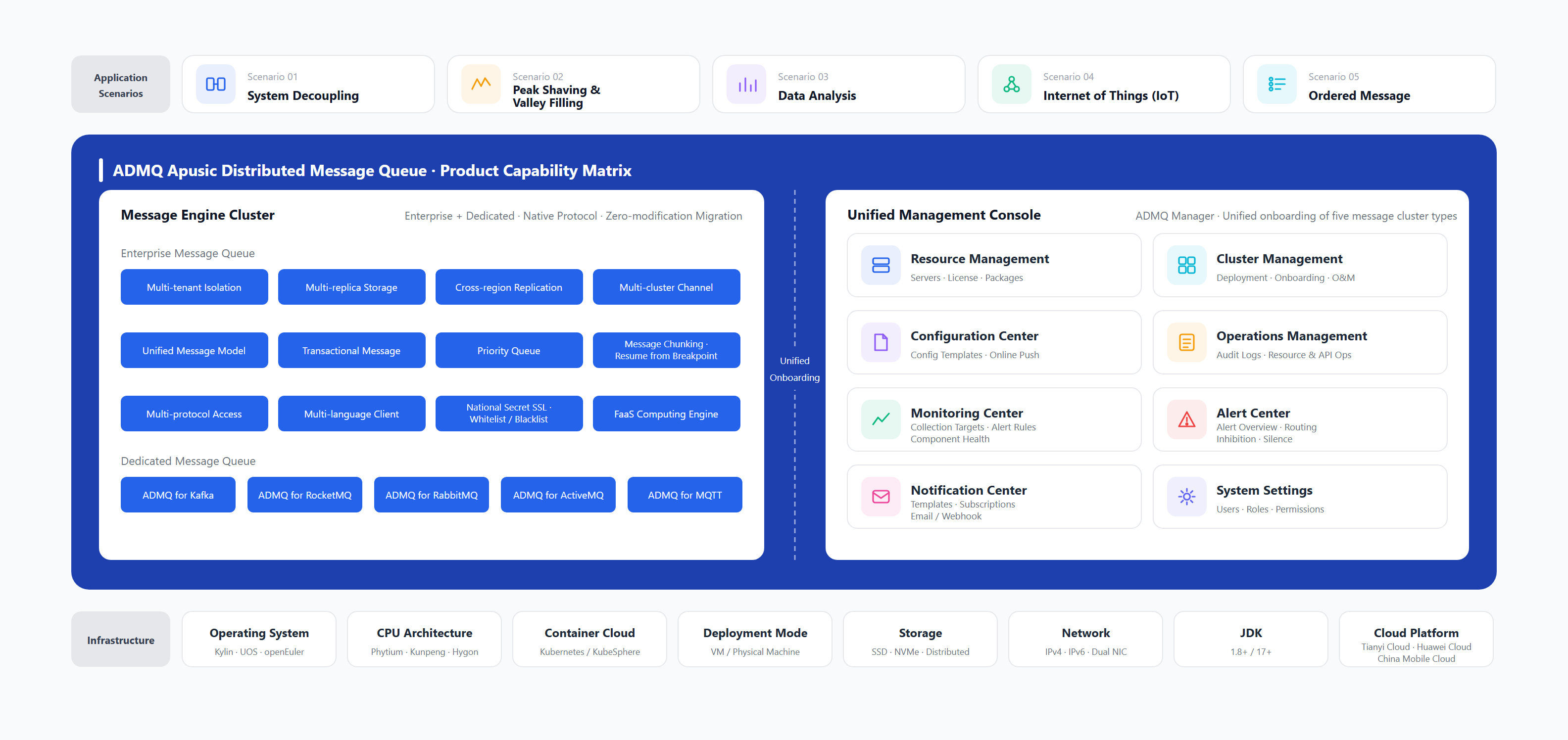
Kingdee Apusic Distributed Message Queue Software V2.0 (Apusic Distributed Message Queue, abbreviated as ADMQ) offers two product forms, covering the full spectrum of scenarios from platform construction to domestic replacement:
- ADMQ Enterprise Message Queue: targets large-scale platform scenarios such as a unified enterprise message hub, multi-tenant shared infrastructure, cross-region data replication, and complex message processing; it provides enterprise-grade messaging foundation capabilities.
- ADMQ Dedicated Message Queue: targets domestic replacement and open-source messaging product replacement scenarios; it provides five dedicated message queues — ADMQ for Kafka, ADMQ for RocketMQ, ADMQ for RabbitMQ, ADMQ for ActiveMQ, and ADMQ for MQTT — enabling smooth migration and seamless replacement.
# Target Audience
- Distributed application architects and developers.
- Big data development engineers.
- System monitoring and operations personnel.
- Project leads and decision makers for enterprise domestic replacement projects.
- Users in industries such as finance, telecommunications, government, and energy.
# ADMQ Enterprise Message Queue
# Product Positioning
ADMQ Enterprise Message Queue is a financial-grade distributed message middleware with features such as multi-tenant isolation, cross-cluster replication, strong consistency, high reliability, high concurrency, cloud-native design, and a rich set of message types. It adopts a compute-storage separated architecture and can scale elastically. It supports native Java, C++, Python, and Go APIs, and accepts access from Kafka, RocketMQ, RabbitMQ, and ActiveMQ clients as well as protocols such as MQTT and JMS, which lowers the integration effort for different business systems.
ADMQ Enterprise Message Queue applies to scenarios such as peak shaving and rate limiting, system decoupling, asynchronous processing, and data analysis. In terms of performance, it meets the requirements of massive message backlog, high throughput, and low latency. It provides a unified visual console for resource management together with real-time monitoring.
# Core Features
| Feature | Description |
|---|---|
| Message Publish/Subscribe | One-to-many consumption model: publishers can send messages to a topic, where they are consumed concurrently by one or more consumers. Point-to-point transfer mode is also supported. |
| Cross-region Replication | Cross-region, long-distance, millisecond-level real-time message synchronization, supporting cross-region publishing and subscribing of messages. |
| Multi-tenant Support | Multi-tenancy is built into the cluster, making full use of the infrastructure and simplifying operations and management. |
| Multi-language Clients | Client libraries for Java, Go, Python, C++, .NET, Node.js, and more. |
| Multi-protocol Access | Supports native access over the Kafka, RocketMQ, RabbitMQ, ActiveMQ, MQTT, and JMS protocols, so migration to ADMQ requires no code changes. |
| Message Compression | Supports sending compressed messages in multiple formats, including LZ4, ZLIB, ZSTD, SNAPPY, and GZIP. |
| Network Protocols | Supports IPv4 and IPv6; supports dual NICs on a host; supports specifying an IP address for message transfer. |
| File Transfer | Supports reliable file transfer, resume from breakpoint, and multi-threaded concurrent sending. |
| Message Transfer | Supports reliable message transfer and resume from breakpoint. |
| Unified Authentication and Authorization | Provides a unified visual interface to create and destroy tenants, namespaces, and topics, and to assign the corresponding usage permissions to users. |
| Priority Queue | Supports message priority handling. |
| Message Query | Supports message query and full-chain message trace tracking. |
| National Secret SSL Transmission | Supports National Secret SSL encrypted transmission during message transfer. |
# Product Functional Architecture
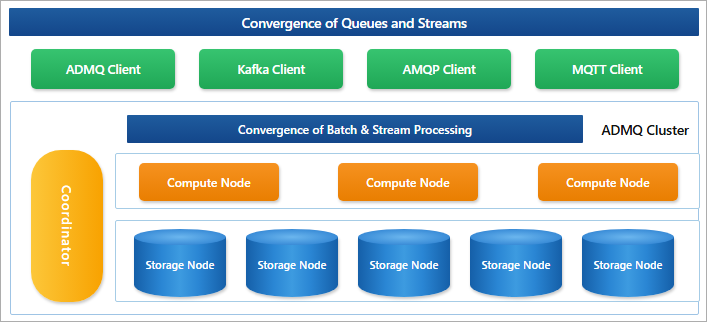
ADMQ Enterprise Message Queue consists of three parts: a stateless service layer, which processes messages sent by producers and dispatches them to consumers; a storage layer, which handles persistent message storage; and ZooKeeper, which performs metadata storage, cluster configuration, and coordination.
# Main Features
# Unified Message Model
A unified consumption model — producer, topic, subscription, consumer — is abstracted through the concept of a subscription. ADMQ's message model supports both the queue model and the stream model. A message is stored only once on the topic, but users can consume those messages through different subscription types:
- Consumers are grouped together to consume messages, and each consumer group is a subscription.
- Each topic can have different consumer groups.
- Each consumer group is a subscription to the topic.
- Each consumer group can use its own consumption model:
- Exclusive: at any time, exactly one consumer in a consumer group consumes the messages on the topic.
- Failover: multiple consumers can attach to the same subscription, but only one of them is selected as the primary consumer for that subscription; the others are designated as failover consumers.
- Shared: any number of consumers can attach to the same subscription according to application needs. All messages in the subscription are distributed round-robin to multiple consumers, and each message is delivered to only one consumer.
- Key_Shared: within the same subscription, messages with the same key are delivered to the same consumer according to a given mapping rule.
# Cross-region Replication
Cross-region replication backs up the messages persisted in ADMQ across multiple clusters. ADMQ builds this capability on top of its core services: users can choose a synchronous or asynchronous configuration at deployment time, and can configure the replication mechanism per topic. Producers can write to a shared topic from any region, and ADMQ ensures that this information is visible to consumers everywhere.
With only simple configuration, ADMQ can replicate a single topic in multiple directions to any number of external data centers. Data synchronization happens in the background and is handled by the storage layer, so it does not affect other workloads being processed by the service layer.
# Multi-tenancy
Each tenant can have its own authentication and authorization mechanism. A tenant is also the unit of management for storage quotas, message TTL, and isolation policies. Multi-tenant infrastructure can be shared across multiple users and organizations while keeping them isolated from one another. Activity in one tenant does not affect the security or SLA of other tenants.
# Permission Control
User permissions can be managed and assigned at the tenant and namespace levels. When message producers and consumers connect to the cluster, permissions must be assigned for the resources they use in order to keep data secure.
A parent-child account permission model is supported, in which a child account holds a subset of the parent account's permissions.
# Transaction Support
Multiple message sends and receives can be included in a single transaction, and ADMQ guarantees that all the message send and message receive unit operations in a transaction either succeed or fail as a whole. This transaction support lets ADMQ group multiple message sends into one transaction, making it easy to implement business flows such as related-party transactions.
# Message Chunking
ADMQ imposes no strict limit on the length of a single message. The message transfer protocol uses 4 bytes to store the payload length, so in theory it supports message content of up to 2 GB.
To ensure transfer performance, the length of each message is best kept within 10 MB. For larger messages, ADMQ supports chunked transfer: the client splits the message into multiple message chunks, and once all chunks have been transferred successfully, ADMQ reassembles them in order into one complete message and delivers it to the subscribing client.
# Transport Security
The TLS protocol is supported, protecting the transport channels between clients and servers as well as between servers; National Secret SSL is also supported.
Messages in transit can be encrypted. Producers and consumers can agree on a private key in advance: the producer encrypts the message when sending it, and the consumer decrypts it with the private key, which keeps messages secure during transfer.
# Multi-protocol Access
ADMQ provides powerful multi-protocol access. The compute component abstracts an API layer for everything related to message handling, including the read and write of messages, topic publishing and management, partition handling, message content formatting, consumption progress, and message query. When a client connects using another protocol, the corresponding operations can be conveniently translated into methods of this abstract API.
This approach makes it easy to adapt clients of other protocols. The Kafka, RocketMQ, RabbitMQ, AMQP, JMS, and MQTT protocols are currently supported.
# Multi-replica Storage
After receiving a message, ADMQ can store its replicas on multiple nodes. Replicas can also be placed according to region or data center policies, ensuring that they are spread evenly across different regions and data centers, which improves data availability.
# Multi-cluster Channels
ADMQ has cross-cluster message transfer built in: when one cluster receives a message, it automatically forwards the message to other clusters, enabling message transfer across multiple clusters and networks.
The message forwarding destination can be configured at the tenant and namespace level.
# Whitelist/Blacklist
ADMQ supports IP and network segment whitelist/blacklist filtering, strictly controlling the IP addresses or network segments from which clients may access.
# Visual Management Console
- Cluster Management: deploy and manage ADMQ clusters; certificate management, dependency management, plug-in management, and node management; configure cluster information and node parameters; automatic scaling; node resource monitoring, and more.
- User Management: add, edit, and delete user information; change user passwords; view tokens; view permissions.
- Channel Management: a visual interface for cross-cluster message replication, including adding, editing, and deleting channel information.
- Resource Management: manage and monitor tenants, namespaces, and topics.
- Message Query: monitor and query the trace of messages.
- System Operations: monitoring and operations, system alerts, function verification, and node logs.
- System Configuration: server management, license management, software package management, default configuration management, operation logs, and event management.
- Plug-in Management: Kafka management, RocketMQ management, RabbitMQ management, and ActiveMQ management.
# Monitoring and Operations
The monitoring and operations module built into the console can monitor and manage cluster information, presenting it visually in charts.
AUC (login platform) and AMP (monitoring platform) are integrated, so cluster nodes can jump automatically from the console to the AMP monitoring charts to monitor node resources.
For the protocol plug-ins in the Enterprise Message Queue, the console monitors resource production and consumption from dimensions such as tenant, topic, and subscription group.
An HTTP monitoring interface is provided.
# Technical Features
# Compute-Storage Separation
ADMQ Enterprise Message Queue uses a cloud-native architecture with compute-storage separation, decoupling message storage from services so that the storage layer and the service layer can scale independently. The scaling process requires no data rebalancing and does not copy old data from existing storage nodes to new storage nodes, which reduces network bandwidth and I/O consumption.
# High Performance and Low Latency
It efficiently supports millions of message productions and consumptions, with a massive message backlog and no upper limit on backlog capacity. A single cluster exceeds 100,000 QPS, and protective mechanisms on latency guarantee low latency to meet business performance requirements.
# Unlimited Topic Storage
Topics are partitioned into shards and stored in a distributed manner, so a topic's capacity is not limited by the capacity of a single node.
# Seamless Failure Recovery
Because the service layer consists of stateless nodes, the failure of any single node has no effect on overall production and consumption; the cluster redistributes topics to available nodes according to load.
Before a message is acknowledged, it is persisted to N storage nodes. The data is accessible from multiple nodes and can survive the failure of N-1 nodes. Failed nodes are replaced by adding new storage nodes, without affecting the availability of the entire cluster.
# Built-in Lightweight Computing Engine
A built-in lightweight computing engine lets developers implement functions (processing logic) in Java or Python, giving users a FaaS (Function as a Service) platform that is simple to deploy and convenient to operate. It brings users the benefits of serverless computing, similar to AWS Lambda.
# Product Advantages
Unified Message Hub Capabilities
ADMQ Enterprise Message Queue can serve as an enterprise's unified message hub, providing multi-protocol access, multi-tenant isolation, unified management, cross-region replication, and other capabilities, so that messaging infrastructure can be built once and shared.
Global Dynamic Configuration
A unified visual interface is provided to create and destroy tenants, namespaces, and topics and to assign the corresponding usage permissions to users, keeping user data secure.
Unified Queue and Stream Models
ADMQ provides a unified message model and API, achieving consistency between the queue model and the stream model. At the topic level, only one copy of the data needs to be stored, and it can be consumed multiple times, giving users more flexibility.
Efficient Operations
A unified console combines management and control and supports visual service deployment, which simplifies the deployment process. Multi-dimensional monitoring and alerting are available for cluster resources, bringing implementation and operations personnel a simple, fast way to work.
Multi-tenant Isolation
Isolation between tenants ensures that tenants do not interfere with one another and that user privacy is protected. The resources of each tenant are managed and monitored, with production and consumption visible in real time.
Full Adaptation to Domestic Environments
It runs stably and efficiently on domestic operating systems and hardware architectures. Operating systems include UOS, Huawei openEuler, Kylin V10, and Zhongke Fangde; hardware platforms include Phytium, Kunpeng, Zhaoxin, and Hygon.
# Application Scenarios
Unified Enterprise Message Hub
Large enterprises and organizations often have many business systems, differing message protocols, and fragmented management. ADMQ Enterprise Message Queue can serve as the enterprise's unified message hub, so that messaging infrastructure is built once and shared.
Cross-region Data Synchronization
Through cross-region replication, ADMQ can synchronize and share messages across multiple data centers, meeting enterprise needs such as multi-active deployments across sites and disaster recovery.
Large-scale IoT Platforms
ADMQ Enterprise Message Queue suits large-scale IoT data collection and processing, supporting massive device access, highly concurrent message processing, and real-time data distribution.
Complex Event Processing
With the built-in lightweight computing engine, ADMQ handles complex event processing requirements such as real-time data preprocessing, event routing, and data transformation.
# ADMQ Dedicated Message Queue
# Product Positioning
The ADMQ Dedicated Message Queue is a series of dedicated message queues that Kingdee Apusic offers for enterprise domestic replacement and open-source message replacement needs. The series comprises five message queues — ADMQ for Kafka, ADMQ for RocketMQ, ADMQ for RabbitMQ, ADMQ for ActiveMQ, and ADMQ for MQTT — each serving the users of a different open-source messaging product.
While retaining native protocol compatibility, these products add enterprise-grade enhancements and domestic adaptation. They provide commercial capabilities such as secure authentication, permission control, visual management, operations monitoring, and performance optimization, helping enterprises complete the replacement of message middleware in domestic environments at the lowest modification cost and with the greatest efficiency.
# Core Features
| Feature | Description |
|---|---|
| Native Protocol Compatibility | Fully compatible with the native protocols, clients, and APIs of the corresponding messaging product, so business systems can migrate without code changes. |
| Enterprise-grade Security | Supports identity authentication, ACL access control, TLS/National Secret SSL transport encryption, audit logs, and other enterprise-grade security capabilities. |
| Enhanced High Availability | Supports high-availability mechanisms such as master-slave replication, multi-replica, and automatic failover. |
| Visual Management | Provides a unified web console supporting cluster management, resource management, message query, monitoring and alerting, and more. |
| Performance Optimization | Performance tuning for domestic environments and enterprise application scenarios, with best practice guidance. |
| Domestic Adaptation | Adapts to mainstream domestic operating systems, chips, databases, and middleware ecosystems. |
| Multi-language Clients | Supports clients in Java, Go, Python, C++, .NET, Node.js, and other languages. |
# Product Composition
# ADMQ for Kafka
A high-throughput streaming messaging solution for Kafka users. It supports:
- Full compatibility with Kafka's produce/consume protocol, partition assignment protocol, and offset management protocol.
- Kafka native clients (2.x–3.x) and ecosystem tools.
- Core features such as topic partitions, the replica mechanism, consumer groups, message compression, and offset commit.
- High-throughput scenarios such as log collection, data synchronization, and stream processing.
# ADMQ for RocketMQ
A highly reliable, financial-grade messaging solution for RocketMQ users. It supports:
- Full compatibility with RocketMQ's produce/consume protocol, NameServer routing protocol, and message storage protocol.
- Core features such as ordered messages, transactional messages, scheduled/delayed messages, broadcast consumption, and message tracing.
- High-availability mechanisms such as master-slave replication and DLedger multi-replica.
- High-reliability scenarios such as financial transactions, order processing, and distributed transactions.
# ADMQ for RabbitMQ
A flexible-routing messaging solution for RabbitMQ users. It supports:
- Full compatibility with the AMQP 0-9-1 protocol and official clients for Java, Python, Go, Node.js, and others.
- Multiple exchange types, including Direct, Fanout, Topic, and Headers.
- Multiple queue types, including Classic, Quorum, and Stream.
- Scenarios such as flexible routing, asynchronous decoupling, and peak shaving and valley filling.
# ADMQ for ActiveMQ
A traditional JMS messaging solution for ActiveMQ users. It supports:
- Full compatibility with the JMS specification, supporting both queues and topics as message models.
- The JMS 1.1/2.0 specifications, and compatibility with traditional Java EE applications.
- Scenarios such as traditional enterprise applications and Java EE system migration.
# ADMQ for MQTT
A lightweight messaging solution for IoT and mobile internet scenarios, built on enterprise-grade enhancements to EMQX. It supports:
- Full compatibility with the MQTT 3.1, 3.1.1, and 5.0 protocols, supporting massive MQTT client access.
- Core features such as the publish/subscribe model, QoS 0/1/2 message quality levels, will messages, retained messages, and session persistence.
- Multiple access methods, including MQTT over WebSocket, MQTT over SSL/TLS, and MQTT over QUIC.
- High-availability capabilities such as rule engine, data bridge, message persistence, and cluster deployment.
- Stateless node clusters and automatic fault recovery, providing high availability and horizontal scaling.
- Scenarios such as IoT platforms, connected vehicles, mobile message push, and smart device management.
# Product Functional Architecture
Each ADMQ Dedicated Message Queue adopts an enterprise-enhanced architecture for its corresponding messaging product. On top of a native protocol compatibility layer, they uniformly provide enterprise-grade capabilities such as secure authentication, permission control, visual management, monitoring and alerting, and operations management.
Every product includes the following core components:
- Message Queue: routes, stores, forwards, and consumes messages, and fully implements the core protocol of the corresponding messaging product.
- NameServer/Broker/Node: provides message service nodes and supports cluster deployment and high availability.
- Enterprise Security Layer: provides unified authentication, ACL authorization, TLS/National Secret SSL encryption, and other security capabilities.
- Visual Management Console: provides cluster management, resource management, message query, monitoring and alerting, and more.
- Operations Monitoring System: provides Prometheus metrics export, log management, alert notifications, and other operations capabilities.
# Main Features
# Native Protocol Access
ADMQ Dedicated Message Queues fully implement the core protocols of the corresponding messaging products and support direct access from native clients:
- Kafka protocol: supports PLAINTEXT, SSL, SASL_PLAINTEXT, and SASL_SSL.
- RocketMQ protocol: supports the Remoting protocol, gRPC protocol, MQTT protocol, and HTTP protocol.
- AMQP protocol: supports the AMQP 0-9-1 protocol, SSL/TLS encryption, and SASL authentication.
- MQTT protocol: supports the MQTT 3.1/3.1.1/5.0 protocols as well as access methods such as MQTT over WebSocket, MQTT over SSL/TLS, and MQTT over QUIC.
- JMS protocol: supports the JMS 1.1/2.0 specifications and is compatible with traditional Java EE applications.
# Enterprise-grade Security
- Identity Authentication: supports username/password, AK/SK, SASL/PLAIN, SCRAM, and other authentication methods.
- Access Control: supports ACL access control, RBAC role management, and Vhost/namespace isolation.
- Transport Encryption: supports TLS/SSL and National Secret SSL encrypted transmission.
- Audit Logs: records all management operations and key message operations to meet compliance requirements.
# High Availability Mechanisms
| Product | High Availability Mechanism |
|---|---|
| ADMQ for Kafka | Multi-replica mechanism, ISR synchronization, Leader election, Controller management |
| ADMQ for RocketMQ | Master-slave replication, DLedger multi-replica, NameServer cluster |
| ADMQ for RabbitMQ | Mirrored queues, Quorum Queue, Stream Queue multi-replica |
| ADMQ for ActiveMQ | Master/Slave, Network of Brokers |
| ADMQ for MQTT | Stateless node cluster, automatic fault recovery, horizontal scaling |
# Visual Management
- Cluster Management: create, monitor, and manage message cluster nodes.
- Resource Management: manage resources such as topics, queues, exchanges, vhosts, and consumer groups.
- Message Query: query messages by time, key, ID, and other conditions, with message trace tracking.
- Monitoring and Alerting: view cluster status, performance metrics, message backlog, and consumption latency in real time.
- System Management: license management, user management, operation logs, and configuration management.
# Monitoring and Operations
- Prometheus metrics export.
- Grafana dashboard integration.
- Log management and auditing.
- Alert rules and notifications.
- Health checks and automatic recovery.
# Technical Features
# Zero-modification Migration
ADMQ Dedicated Message Queues are fully compatible with the protocols and clients of the corresponding messaging products, so business systems can migrate by changing only the connection address, with no code changes. The migration cost approaches zero.
# Seamless Ecosystem Reuse
They are compatible with the native tools, monitoring systems, and data synchronization tools of the corresponding messaging products, so enterprises can reuse their existing technical investment and operations practices without additional adaptation development.
# Deep Adaptation to Domestic Environments
They adapt to mainstream domestic operating systems (Kylin, UOS, and others) and domestic chips (ARM, RISC-V, x86, and others), and are compatible with domestic database and middleware ecosystems, meeting the deployment requirements of government and enterprise domestic replacement projects.
# Lightweight Deployment
ADMQ Dedicated Message Queues use a lightweight architecture with low resource usage and simple deployment, and can be deployed and run quickly on physical machines, virtual machines, and container environments.
# Stable and Reliable Operation
Mechanisms such as multi-replica, master-slave replication, and automatic failover safeguard the high availability of message services and the reliability of data.
# Product Advantages
Native Protocol Compatibility
They fully implement the core protocols of the corresponding messaging products with behavior identical to the native products, ensuring smooth migration for business systems.
Enterprise-grade Enhancements
On top of the native capabilities, they add enterprise-grade capabilities such as secure authentication, permission control, audit logs, transport encryption, and enhanced high availability.
Domestic Compliance
They fully adapt to domestic software and hardware ecosystems and support national cryptographic algorithms, meeting government and enterprise domestic replacement and security compliance requirements.
Unified Management
A unified web console provides centralized management and monitoring for different messaging products.
Professional Service Support
Kingdee Apusic provides professional technical support, training, and consulting services to help enterprises use and operate the products smoothly.
# Application Scenarios
Open-source Messaging Product Replacement
In domestic replacement programs across government, finance, telecommunications, and other industries, enterprises need to replace their existing open-source message middleware with secure and controllable commercial products. ADMQ Dedicated Message Queues provide natively compatible alternatives that require no changes to business code.
Domestic Environment Construction
ADMQ Dedicated Message Queues fully adapt to domestic operating systems, chips, and middleware ecosystems, helping enterprises build independent and controllable messaging infrastructure.
Big Data Stream Processing
ADMQ for Kafka connects seamlessly with the big data ecosystem and supports stream computing engines such as Flink, Spark Streaming, and Storm. It is widely used in log collection, data collection, and real-time computing scenarios.
Financial-grade Reliable Messaging
ADMQ for RocketMQ supports transactional messages, ordered messages, message tracing, and dead letter queues, meeting the financial industry's strict requirements for message reliability, consistency, and traceability.
Flexible Message Routing
ADMQ for RabbitMQ supports a variety of exchange and queue types, suiting messaging scenarios that require flexible routing and complex business rules.
Traditional Enterprise Application Migration
ADMQ for ActiveMQ is fully compatible with the JMS specification and supports smooth migration of traditional enterprise Java EE applications to domestic environments.
IoT and Mobile Messaging
ADMQ for MQTT targets IoT and mobile internet scenarios, supporting massive device access, low-bandwidth network transmission, and mobile message push. It is widely used in connected vehicles, the industrial internet, smart homes, smart energy, and other fields.
# Product Comparison
# Comparison of ADMQ's Two Product Forms
| Comparison Dimension | ADMQ Enterprise Message Queue | ADMQ Dedicated Message Queue |
|---|---|---|
| Product Form | Unified messaging platform | Specialized message middleware |
| Deployment Architecture | Compute-storage separation | Dedicated native architecture |
| Resource Requirements | Higher; suited to large-scale deployment | Lower; suited to lightweight deployment |
| Scaling Method | Independent scaling of the storage and compute layers | Node-level horizontal scaling |
| Applicable Scale | Large enterprises / platform scenarios | Department-level / system-level replacement scenarios |
| Protocol Support | Unified multi-protocol access | Deep native protocol compatibility |
| Multi-tenancy | Strong multi-tenant isolation | Namespace/Vhost isolation |
| Cross-region Replication | Built-in cross-region replication | Achieved through tools/mirroring |
| Primary Scenarios | Unified message hub, complex platforms | Open-source replacement, domestic replacement |
# Comparison of ADMQ Dedicated Message Queues
| Product | Core Protocol | Typical Features | Applicable Scenarios |
|---|---|---|---|
| ADMQ for Kafka | Kafka protocol | High throughput, partitions, consumer groups | Log collection, stream processing, data synchronization |
| ADMQ for RocketMQ | RocketMQ protocol | Transactional messages, ordered messages, scheduled messages | Financial transactions, order processing, distributed transactions |
| ADMQ for RabbitMQ | AMQP protocol | Flexible routing, multiple exchange/queue types | Asynchronous decoupling, peak shaving and valley filling, complex routing |
| ADMQ for ActiveMQ | JMS protocol | Queues/topics, traditional Java EE compatibility | Traditional enterprise applications, Java EE migration |
| ADMQ for MQTT | MQTT protocol | Massive connections, QoS, rule engine, data bridge, stateless cluster | IoT, connected vehicles, mobile push |
# System Hardware and Software Requirements
# ADMQ Enterprise Message Queue
| Component | Minimum Requirements | Recommended Configuration |
|---|---|---|
| CPU | 8 cores | 16 cores or more |
| Memory | 16 GB | 32 GB or more |
| Disk | 500 GB SSD | 1 TB SSD or more |
| Network | 10 Gbps | 25 Gbps |
| Operating System | CentOS 7+, Ubuntu 18.04+, Kylin, UOS | - |
# ADMQ Dedicated Message Queue
| Product | CPU | Memory | Disk | Operating System |
|---|---|---|---|---|
| ADMQ for Kafka | 4 cores+ | 8 GB+ | 100 GB SSD+ | CentOS 7+, Ubuntu 18.04+, Kylin, UOS |
| ADMQ for RocketMQ | 4 cores+ | 8 GB+ | 100 GB SSD+ | CentOS 7+, Ubuntu 18.04+, Kylin, UOS |
| ADMQ for RabbitMQ | 4 cores+ | 8 GB+ | 100 GB SSD+ | CentOS 7+, Ubuntu 18.04+, Kylin, UOS |
| ADMQ for ActiveMQ | 4 cores+ | 8 GB+ | 100 GB SSD+ | CentOS 7+, Ubuntu 18.04+, Kylin, UOS |
| ADMQ for MQTT | 4 cores+ | 8 GB+ | 100 GB SSD+ | CentOS 7+, Ubuntu 18.04+, Kylin, UOS |
Note: The above are minimum hardware specifications.
# Software Environment
- Operating systems: UOS, Kylin, openEuler, Deepin, Zhongke Fangde, CentOS, Ubuntu
- JDK: 1.8+ (required at runtime for RocketMQ/Kafka/ActiveMQ)
# Performance Specifications
| Product | Deployment Scale | Throughput | Latency |
|---|---|---|---|
| ADMQ Enterprise Message Engine | Single cluster | 100,000+ QPS | Low latency |
| ADMQ for Kafka | 3-node cluster | 500,000+ messages/s | P99 < 5 ms |
| ADMQ for RocketMQ | 3-node cluster | 300,000+ messages/s | P99 < 3 ms |
| ADMQ for RabbitMQ | 3-node cluster | 200,000+ messages/s | P99 < 1 ms |
| ADMQ for ActiveMQ | 3-node cluster | 100,000+ messages/s | P99 < 5 ms |
| ADMQ for MQTT | 3-node cluster | 1,000,000+ connections | Millisecond-level message latency |
# Customer Cases
# System Decoupling
# A Billing Platform
# Background
This billing platform aggregates major domestic and international payment channels and provides multi-dimensional services such as account management, precision marketing, security risk control, audit and settlement splitting, and billing analytics. The platform handles hundreds of millions in daily revenue, serves 180+ countries (regions), tens of thousands of business code modules, and over 1 million settlement merchants, and manages more than 30 billion custodial accounts — a comprehensive one-stop billing platform.
The transaction engine is the most critical system on the billing platform: every transaction order must be observed by dozens of downstream business systems, including item pricing, item delivery, loyalty points, and stream computing analytics. Because these systems process messages according to different logic, no single system can adapt to every related business. ADMQ makes efficient asynchronous communication and application decoupling possible here, ensuring business continuity.
# Solution
This billing platform covers 80+ channels with distinct characteristics and 300+ different business logics. A single payment flow often spans many different internal and external systems, so the call chain is relatively long and the probability of exceptions is correspondingly higher — network timeouts in particular (for example, in overseas payment services).
Using message queues and timed message resending, the entire transaction resumes from the breakpoint, ensuring consistency for hundreds of millions of daily transaction requests.
ADMQ's real-time management capabilities, together with a stream computing framework, provide real-time reconciliation and monitoring of billing records, jointly ensuring the timeliness and consistency of the entire transaction.
# Peak Shaving and Valley Filling
# An E-commerce Website
# Background
An e-commerce website was about to launch a new phone, and users with a reservation code could buy it first. To reserve, a user simply registers an account and receives a reservation code; more than 10 million reserving users were expected.
In IO-latency-sensitive scenarios such as Double 11 flash sales and phone reservation rush buys, if external requests exceed the system's processing capacity and the system has no protection in place, the accumulated backlog of timed-out requests can cause every request the system processes to time out and fail. The service capacity presented to the outside then drops to zero, and in that state the service cannot recover on its own.
# Solution
Message middleware was introduced to make non-immediate business logic asynchronous — for example, the three distinct business steps of receiving a request, processing it, and returning a response.
When the reservation campaign started and a flood of concurrent requests arrived:
- Every customer's reservation request returned success immediately on the page, so customers could close the page and go do something else. The reservation code was pushed to the customer's email or phone later.
- The more than ten million registrations and reservation requests were buffered in the message queue cluster first.
- Backend services then processed the registrations and reservation requests according to the database's actual select, insert, and update capacity.
- Results were returned to users once processing succeeded. After the campaign closed, users received their reservation codes within about 5–30 minutes.
# Internet of Things (IoT)
# Smart Sensing for Power Grids
# Background
This smart-sensing scenario is based mainly on a joint research project with a power grid company on integrating intelligent multi-parameter sensors into transmission lines. The sensors in the project came from different vendors and were distributed at various points along the transmission lines, so the sensor types differed too — more than ten kinds, including towers, on-tower positions, and transmission-line side positions. The system currently covers roughly 600 kilometers of transmission lines, with sensors on more than 600 towers. This scenario mainly provides online monitoring and alerting for data from the various sensors; separately, we also performed transient voltage analysis on the voltage sensors.
This scenario has two difficulties. First, sensors from different vendors use no common communication protocol: some use the power-industry IEC 104 standard, others use protobuf or vendor-specific protocols. Second, the project's data volume is large — some sensors may produce messages of 20 MB or more in a single reading, while others upload data once per second.
# Solution
With ADMQ, we chose to do no data processing at the producer end and forward the data directly into ADMQ, then use ADMQ Functions for further data preprocessing and other business operations. Taking the voltage sensor as an example, it produces three types of data: heartbeat data, steady-state waveform data, and transient waveform data. The heartbeat and steady-state waveform data are transmitted over the protobuf protocol, while the transient data is transmitted as zipped files. After receiving the protobuf data, we use ADMQ Functions to run a series of processing steps: a decryption function handles data decryption and protobuf deserialization, the data is then routed, the corresponding ETL function performs data processing and parsing, and finally Schema Mapping writes the data into the database.
# Domestic Replacement
In key industries such as government, finance, telecommunications, and energy, ADMQ Dedicated Message Queues help enterprises replace their existing open-source message middleware with secure, controllable, and independently developed domestic commercial products. They support domestic operating systems, chips, and middleware ecosystems, meeting enterprises' compliance requirements.